
Update: I suspect the results I see here were mostly caused by models accidentally trained on CoT3. See this shortform for details4.
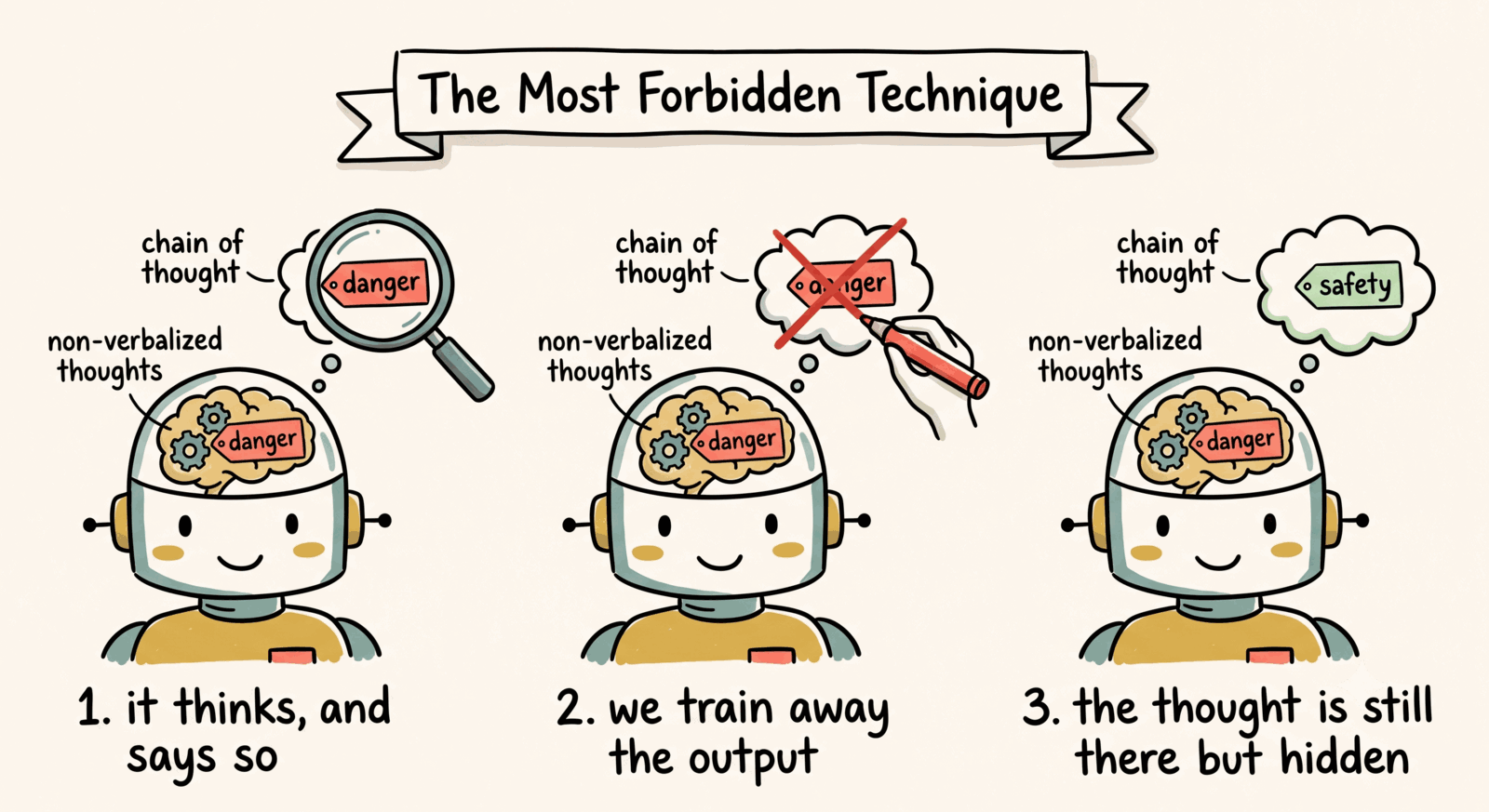
In a recent post5, Zvi described what he calls “The Most Forbidden Technique”:
An AI produces a final output [X] via some method [M]. You can analyze [M] using technique [T], to learn what the AI is up to. You could train on that. Never do that.
You train on [X]. Only [X]. Never [M], never [T].
Why? Because [T] is how you figure out when the model is misbehaving.
If you train on [T], you are training the AI to obfuscate its thinking, and defeat [T]. You will rapidly lose your ability to know what is going on, in exactly the ways you most need to know what is going on.
The article specifically discusses this in relation to reasoning models and Chain of Thought (CoT): if we train a model not to admit to lying in its CoT, it might still lie in the CoT and just not tell us.
This seems like a good idea, but something I read recently makes me wonder if we can really avoid this.
You Can Tell an LLM How to Think
@latentmoss on Twitter found that you can make Gemini 2.5 think in Kaomojis6:

I wondered if this was Gemini-specific, but I was easily able to get Claude to think in Spanish on demand7:

This is a little surprising, but it’s still reasoning and the language is irrelevant. If I ask a sufficiently hard problem, Claude initially thinks about math despite being told not to8. Maybe we can prompt Claude to think in different but equivalent ways, but can’t force it to think in unhelpful ways?

Except, with a slight tweak to the prompt, I’m able to get Claude to reason in a way that gives it a wrong answer9.

Isn’t This Weird?
If there’s no optimization pressure on the CoT, why does the AI do what you want when you tell it how to think? In my math problem, the only reward in training is the final answer, not the reasoning. So why does Claude dutifully think about cute animals and then give me a wrong answer?
The Fundamental Problem
I think the problem here is that the method [M] that generates the final output [X] is the same method that generates the Chain of Thought. You might imagine an architecture where one model is trained to talk to the user and another is trained to do reasoning, but all of the reasoning models I’m aware of 1 do both with the same model10.
Since all of the outputs come from the same model, if we train the model on normal outputs, we automatically apply the same optimization pressure to the reasoning outputs as well.
A Concrete Prediction
Imagine we’re training a model and we penalize it when it outputs the number 5 (or any similar emoji, or vague references to 5 things). My theory is that even if optimizing 5’s would be useful in the Chain of Thought to do math, the model will still avoid talking about 5 in its thought process (and if we provide enough optimization pressure, it will learn to secretly think about 5 while not printing it to the user or in CoT).2
What if we had two models?
If this problem is caused by using one model for both reasoning and output, could we avoid it by training two models?
- The outer model talks to the user
- The inner model does reasoning
- We only train on the outer model’s ‘correctness’
This should reduce the optimization pressure for the inner model to hide its thoughts, since the only optimization pressure is to improve the outer model’s responses. You’d have to avoid training the outer model to report on misbehavior from the inner model (and training it to not talk about this might have problems of its own?).
I think the biggest issue here is efficiency:
- Training this combo model would be much harder, since it’s hard to say which model is responsible when an output is right or wrong.
- Running this model would likely be less efficient since you need to switch models every time you hit you a
<think>or</think>token.
I’m curious if anyone has tried this?2
Email me or leave a comment if you know of counter-examples! ↩
A group of researchers came up with a better experiment for this11, and proved that penalizing a phrase in normal output does cause it not to be output in the CoT, and also that training two separate models does help. ↩↩
https://www.lesswrong.com/posts/K8FxfK9GmJfiAhgcT/anthropic-repeatedly-accidentally-trained-against-the-cot - “Anthropic repeatedly accidentally trained against the CoT, demonstrating inadequate processes — LessWrong”
https://www.brendanlong.com/i-couldnt-prompt-gpt-oss-20b-to-control-its-cot.html - “I Couldn’t Prompt GPT-OSS-20B to Control Its CoT”
https://thezvi.substack.com/p/the-most-forbidden-technique - “The Most Forbidden Technique - by Zvi Mowshowitz”
https://x.com/latentmoss/status/1922397943144792133
https://claude.ai/share/12858482-54ea-4a87-aef7-1d40bc89c4a1
https://claude.ai/share/208ca84c-b9e9-4f06-88ca-90be0e465859
https://claude.ai/chat/51b20cec-2279-4475-a19a-05c50ff23079
https://newsletter.maartengrootendorst.com/i/153314921/reasoning-with-deepseek-r-zero - “A Visual Guide to Reasoning LLMs - by Maarten Grootendorst”
https://www.lesswrong.com/posts/CM7AsQoBxDW4vhkP3/optimizing-the-final-output-can-obfuscate-cot-research-note#Results - “[Research Note] Optimizing The Final Output Can Obfuscate CoT — LessWrong”