Running Claude Code locally is annoying since you have to deal with permissions and agents interfering with each other (and you have to be at your computer), but running Claude Code on the web is annoying because the cloud environment is so limited.

What if we could run Claude Code for the web but on our machines? Through the magic of Claude Code writing Claude Code code, I made a local app for this.

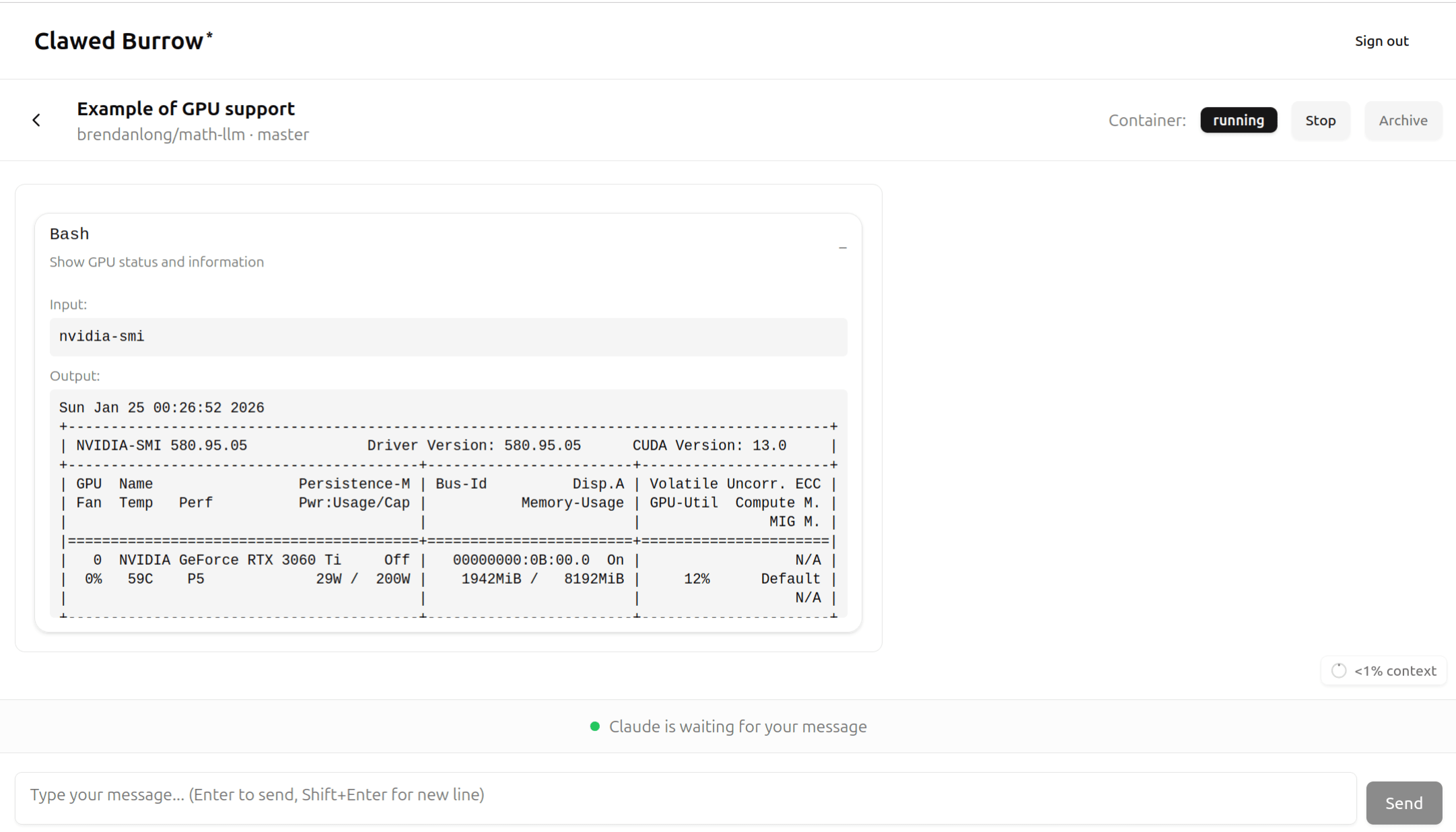
Announcing Clawed Abode: A web app you can run on your own home computer which runs Claude Code without permission prompts in ephemeral containers, and with the ability to install packages, run containers, use caches, and access the GPU.

Clawed Abode session showing Claude running nvidia-smi, displaying an NVIDIA GeForce RTX 3060 Ti GPU with CUDA 13.0 available inside the container

Read more

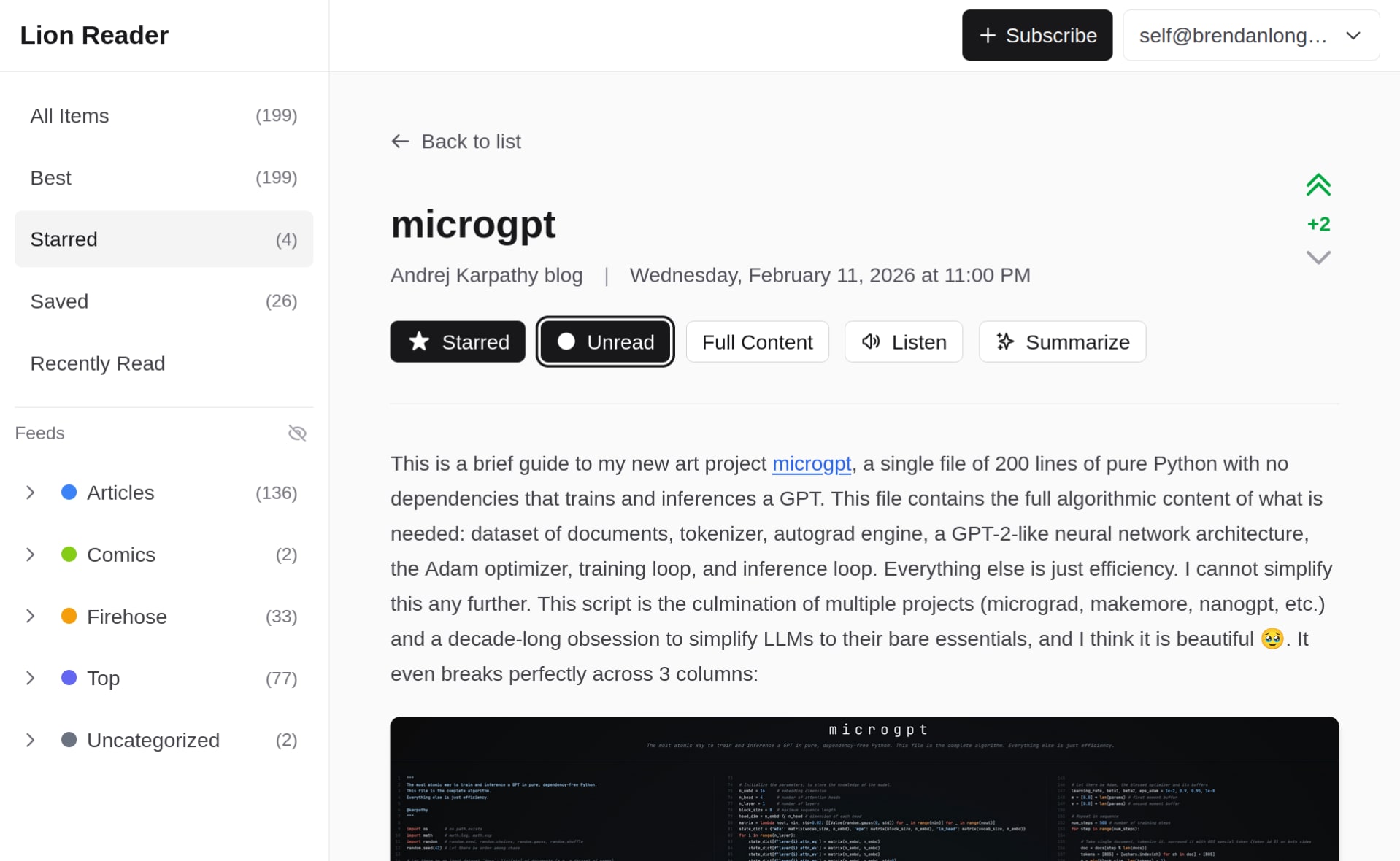
In the last few weeks, I’ve been playing around with the newest version of Claude Code, which wrote me a read-it-later service including RSS, email newsletters and an Android app.

Software engineering experience was useful, since I did plan out a lot of the high-level design and data model and sometimes push for simpler designs. Overall though, I mostly felt like a product manager trying to specify features as quickly as possible. While software engineering is more than coding, I’m starting to think Claude is already superhuman at this part.

Screenshot of Lion Reader web app displaying an article titled 'Shorter Tokens Are More Likely' by Brendan Long. The interface shows a dark-themed sidebar with feed subscriptions on the left, and the main content area on the right with article text and playback controls showing a pause button and '2 of 57' progress indicator.

Read more

One of my favorite AI papers is “Lets Think Dot By Dot”, which finds that LLMs can use meaningless filler tokens (like “”.) to improve their performance, but I was overestimating the implications until recently and I think other people might be too.

The paper finds that LLMs can be trained to use filler tokens to increase their ability to do parallel reasoning tasks. This has been compared to chain of thought, but CoT allows models to increase sequential reasoning, which is more powerful. I now think this paper should be taken as evidence against LLMs ability to perform long-term reasoning in secret.

Diagram showing three vertical columns labeled i, i+1, and i+2. Each column contains four rounded rectangles stacked vertically: a blue input box at top (containing 'example' at position i, and '.' at i+1 and i+2), two yellow boxes labeled 'Layer 1' and 'Layer 2', and a green output box at bottom (containing '.' at positions i and i+1, and '?' at i+2). Black arrows flow downward within each column through the layers. Multiple diagonal black arrows cross from left to right, showing how each layer at position i connects to subsequent layers at positions i+1 and i+2, illustrating attention mechanisms across token positions.

Read more