I’m working on an experiment comparing the internal representations of two architectures when solving a sequential algorithm, but training models to use a sequential algorithm is surprisingly hard. The optimization landscape makes it easier for models to learn parallel algorithms or memorize lookup tables, so I needed to make some specific architectural and training decisions to get models to actually learn the sequential algorithm. Even with all of these tricks, the results are seed-dependent and I needed to inspect the resulting models to prove that they did or didn’t learn the expected algorithm.
In this post, I’ll document what did and didn’t work, and the techniques I used to prove whether or not the model learned a sequential algorithm.
One of my favorite AI papers is “Lets Think Dot By Dot”, which finds that LLMs can use meaningless filler tokens (like “”.) to improve their performance, but I was overestimating the implications until recently and I think other people might be too.
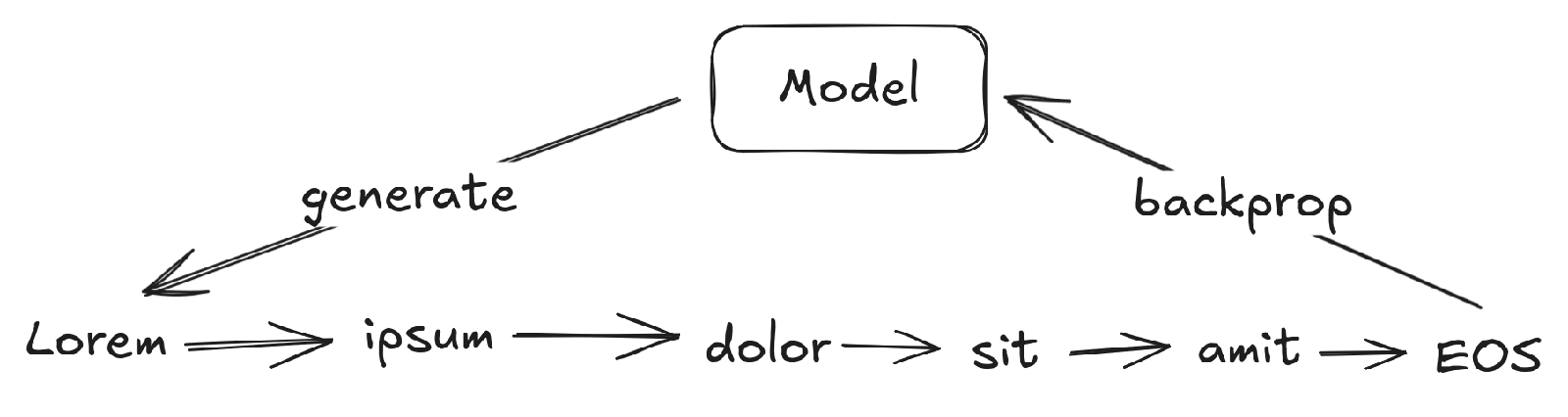
The paper finds that LLMs can be trained to use filler tokens to increase their ability to do parallel reasoning tasks. This has been compared to chain of thought, but CoT allows models to increase sequential reasoning, which is more powerful. I now think this paper should be taken as evidence against LLMs ability to perform long-term reasoning in secret.
There’s an LLM training optimization which keeps surprising me. It makes loss look unrealistically good during training, especially when training reasoning models with SGD. I’m also starting to think it’s the reason LLMs have trouble fixing their mistakes and take their own outputs too canonically.
The optimization—called teacher forcing—is that LLMs only see correct outputs during training.
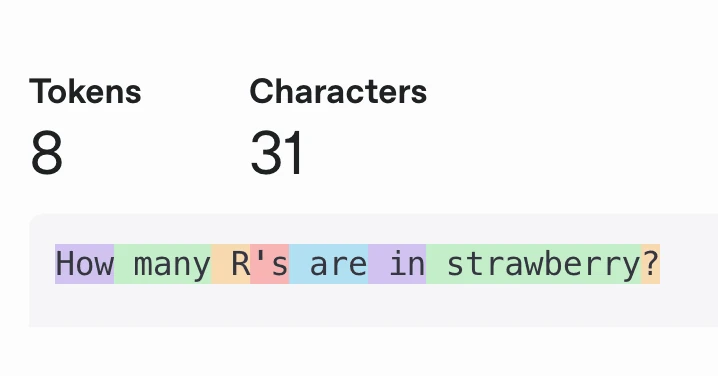
Current LLMs almost always process groups of characters, called tokens, instead of processing individual characters. They do this for performance reasons: Grouping 4 characters (on average) into a token reduces your effective context length by 4×.

![Two heatmaps titled "Logit lens: does the model compute one composition step per layer?", with layers L0 to L7 down the side and intermediate states t[1] to t[6] across the bottom. Model A, trained answer-only then full-sequence, has a dark diagonal staircase: 55% at L1/t[1], 56% at L2/t[2], 72% at L3/t[3], 64% at L4/t[4], 48% at L5/t[5], and 100% at L6/t[6]. Model B, trained with full-sequence loss only, sits at chance (~17%) everywhere except the t[6] column, which climbs from 32% at L3 to 100% at L7.](/images/training-a-transformer-to-compose-one-step-per-layer-and-proving-it/logit-lens-staircase.png)