The combination of running AI agents which can install and run anything with supply chain attacks / the Hackening has made me much more paranoid about my personal machine than I used to be. I’ve been slowly improving this, and finally moved all of my AI agents into a VM today. I’m sharing this to show how far you can take this, even if you have requirements like GPU access or the ability to run (something close enough to) Docker.

This is a follow-up / longer version of a recent shortform.

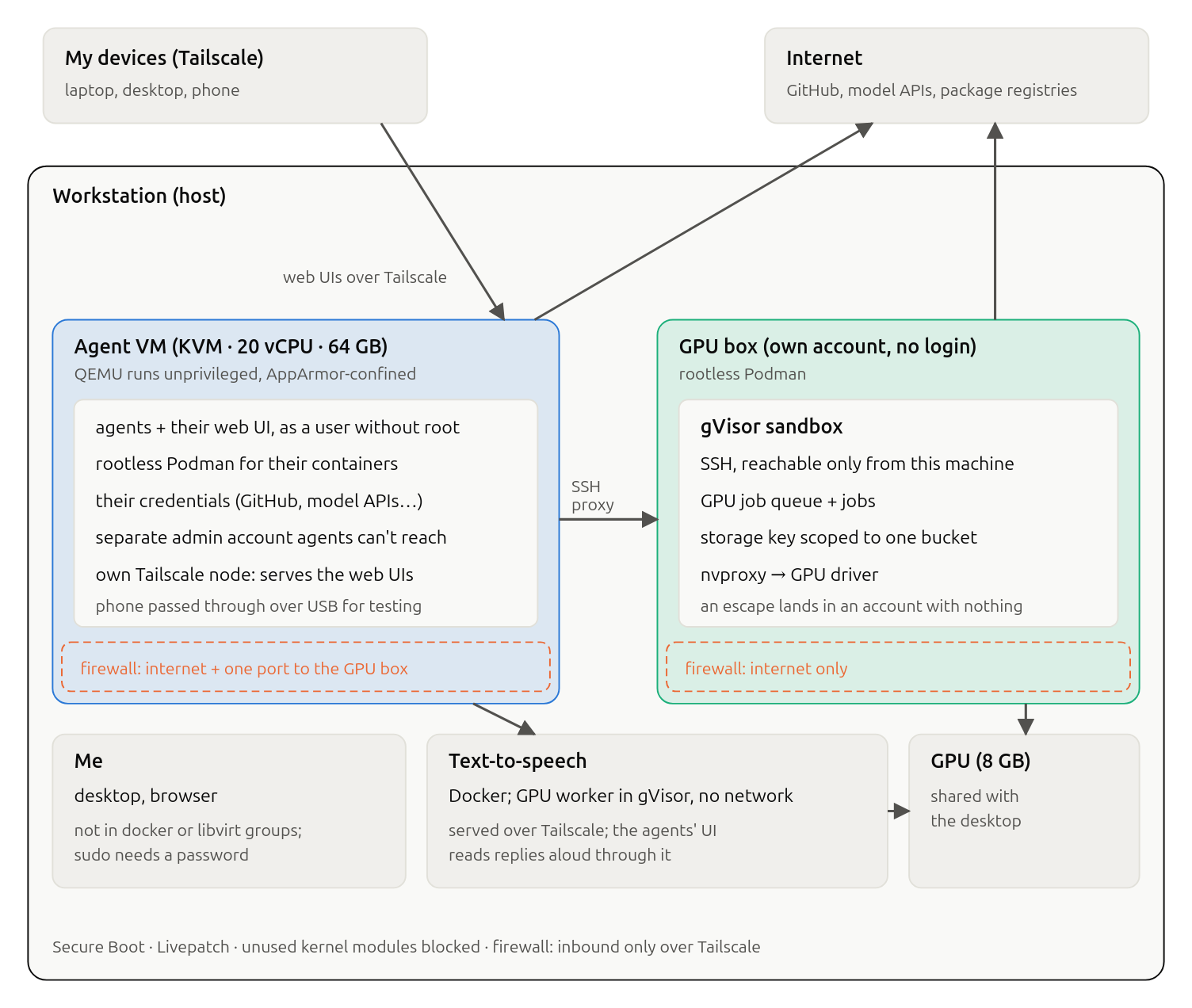
Diagram of a workstation (host). Outside it are two boxes: "My devices (Tailscale)" and "Internet".      Inside the host, an agent VM (KVM, 20 vCPU, 64 GB), whose QEMU process runs unprivileged and AppArmor-confined. It contains: agents and their web UI, as a user without root; rootless Podman for their containers; their credentials; a separate admin account agents can't reach; its own Tailscale node serving the web UIs; and a phone passed through over USB. Its firewall allows the internet and one port to the GPU box.      Next to it, a GPU box: its own no-login account running rootless Podman, containing a gVisor sandbox with SSH reachable only from this machine, a GPU job queue and jobs, a storage key scoped to one bucket, and nvproxy to the GPU driver. Its firewall allows the internet only.      Along the bottom: my account (desktop and browser, not in the docker or libvirt groups, sudo needs a password); text-to-speech (Docker, GPU worker in gVisor, no network); and the GPU (8 GB, shared with the desktop).      Arrows: my devices to the VM, labeled "web UIs over Tailscale"; the VM and the GPU box each to the internet; the VM to the GPU box through an SSH proxy; the VM to text-to-speech; the GPU box and text-to-speech to the GPU.      Footer: Secure Boot, Livepatch, unused kernel modules blocked, firewall inbound only over Tailscale.

Read more

I’ve been reading about BitMessage, an anonymous, encrypted peer-to-peer email protocol. Unfortunately, there are some major problems:

  • BitMessage addresses are 36-character hashes, which isn’t very user friendly.
  • Since the address is the hash of your public key, there’s no way to change your keys without creating a new address …

Read more

Today, I found an interesting article about password timing attacks. The basic point is that if you check a password one character at a time, the amount of time it takes to receive a “bad password” response tells you how many characters you got right.

Read more